Recall that a holomorphic map from a complex manifold to the projective space can be realized by some holomorphic sections of a line bundle on satisfying some conditions. Thus the line bundles on a compllex manifold are important in the study of embedding into the projective spaces. Since divisors are closely related to line bundles, they are also frequently considered. In this setion we introduce a fundamental technique in complex geometry called blowing up, which can reduce singularities of sections and induce divisors from points on complex manifolds.
Construction of blow-ups
Suppose is a polydisc centered at the origin in , with the Euclidean coordinates . Consider the submanifold of given by It is clear that can also expressed as which shows that is a submanifold of the universal bundle on . Let be the natural projection. Then gives a bijective map and is naturally identified with . The manifold , together with the projection , is called the blow-up of at the origin.
Proposition. is an -dimensional complex submanifold of . With respect to this complex structure, is a holomorphic homeomorphism.
Proof: Let be the open subset of given by Consider the holomorphic coordinates of on given by Then it is direct to see that is determined by showing that is an -dimensional complex submanifold of . The corresponding coordinates on are given by
With respect to this complex structure, it is not hard to see that and its inverse are both holomorphic maps, implying that is a holomorphic homeomorphism.
Now suppose is a complex manifold and is a point on . Suppose is a neighborhood of such that under a coordinate map, corresponds to the origin and corresponds to a polydisc centered at the origin. We can consider the blow-up of at , together with the projection .
Let be the manifold obtained by sticking to by , i.e, We see that
extends to a projection ,
has a complex structure obtained from that of and ,
is naturally identified with , and
is a holomorphic homeomorphism.
The complex manifold , together with , is called the blow-up of at the point .
Although the above construction of the blow-up needs the local coordinates near , the result manifold is actually independent of the choice of the coordinates. First note that if is another open neighborhood of with the induced coordinates, then the blow-ups of at constructed from and are naturally holomorphicly homeomorphic to each other. Now suppose is another coordinate system on centered at . Then there are holomorphic functions such that Denote by the blow-up of at given by , together with the projection . We see that there is a holomorphic homeomorphism expressed as and where It is clear that , implying that extends a holomorphic homeomophism
The independence can also be interpreted as that the way we attach to the point is somehow independent of the coordinates.
Suppose is a finite-dimensional complex vector space. We define the associated projective space of to be the set of -dimensional subspace of . admits a structure of complex manifold natually as the complex structure on . If , then any basis of gives a holomorphic homeomorphism from to .
Now is a complex manifold holomorphicly homeomorphic to . The blow-up of at can be identified with the disjoint union of and . The complex stucture of can be determined by specifying that for each and each holomorphic map such that and the tangent map of at is nonzero, the induced map given by is holomorphic.
It is not hard to see that if is a compact complex manifold and is a point in , then the blow-up of at is also compact.
Exceptional divisors
For the blow-up of a complex manifold at a fixed point , we define the exceptional divisor (or for short) to be the inverse image . We have seen that is holomorphicly homeomorphic to .
Proposition. is indeed a divisor on .
Proof: Consider the open cover of , where . On each , we have the coordinate system and it is clear that It follows that is a divisor on given by
As a divisor, induces a line bundle on . Considering the transition functions of , it is not hard to see the following proposition:
Proposition. Under the identification , the line bundle on is isomorphic to the universal bundle on .
It follows that the line bundle on is isomorphic to the hyperplane bundle on . Noting that the fiber of on is naturally identified with the dual space of , we see that each linear functional on gives a global section of . Thus there is a natural map
Lemma. For each nontrivial complex vector space , the canonical map is a linear isomorphism.
Proof: It suffices to show for , that is, to show that the map is a linear isomorphism, where is the space of homogeneous linear functions in .
The injectivity and the linearity are both direct. It remains to show the surjectivity. Suppose is a nonzero homogenuous linear function with the corresponding section . For any nonzero section , defines a meromorphic function on . Composing with the projection , we obatin a meromorphic on . It is direct to see that is a holomorphic function on , which extends to the whole by Hartogs’ theorem. The definition of and implies that for any , and hence by considering the Taylor’s expansion of at , we see that . Clearly corresponds to the section of .
Corollary. The canonical map is an isomorphism.
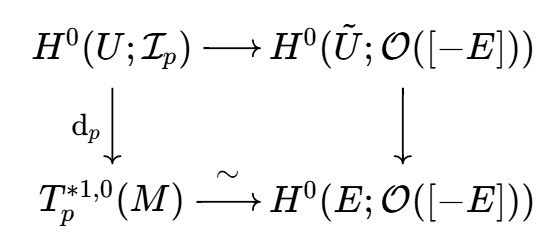
Recall that for a divisor on a complex manifold, each meromorphic function with defines a global holomorphic section of . Note that if is a holomorphic function on a neighborhood of such that , then is a holomorphic function on such that vanishes on , i.e., . Therefore there is a natural map It turns out that this can be realized by taking the differetial of the function at , i.e., the following diagram commutes:
The difference between the canonical bundle on and that on is also described by the exceptional divisor . We see from direct computations of transition functions that the following proposition holds.
Proposition. The canonical bundle on is described as
The last but not the least important thing is how to lift a positive line bundle on to a line bundle on . In general, the pullback of a positive line bundle is no longer positive because the corresponding curvature vanishes along for any . The correct construction is as follows:
Proposition. Suppose is a positive line bundle on . Then there exists a positive integer such that the line bundle on the blow-up is positive for any positive integer .
Proof: Consider an open neighborhood of in . Let where . Then gives a hermitian metric on , which determines a real -form expressed locally as We see that is nonnegative on , and is positive along for any .
Since is a trivial line bundle outside any neighborhood of , we can take a hermitian metric on such that is constant outside a neighborhood of . Take a smooth function on such that , on and outside . Then is a hermitian metric on , with the corresponding form satisfying that vanishes outside , is nonnegative on , and is positive along for any .
Suppose that is a hermitian metric on such that the corresponding -form is positive definite on . Then is a hermitian metric on whose -form is exactly . We can see that is positive outside the holomorphic tangent space of , and vanishes along for any .
Note that is a compact subset, is bounded below on . As is positive on , there exists such that is positive on for any . Now gives a hermitian metric on with the corresponding -form positive definite everywhere, showing that is a positive line bundle on .